I’m obviously not a neutral party here. I teach kiteboarding in Corpus Christi for a living, so of course I’m going to tell you it’s a good place to learn.
But I’ve taught plenty of people who came here after starting somewhere else, and I’ve heard enough comparisons to know what genuinely sets this place apart and where it falls short. So here’s the version with the downsides left in.
The case for Corpus Christi
The Laguna Madre is unusually good learning water
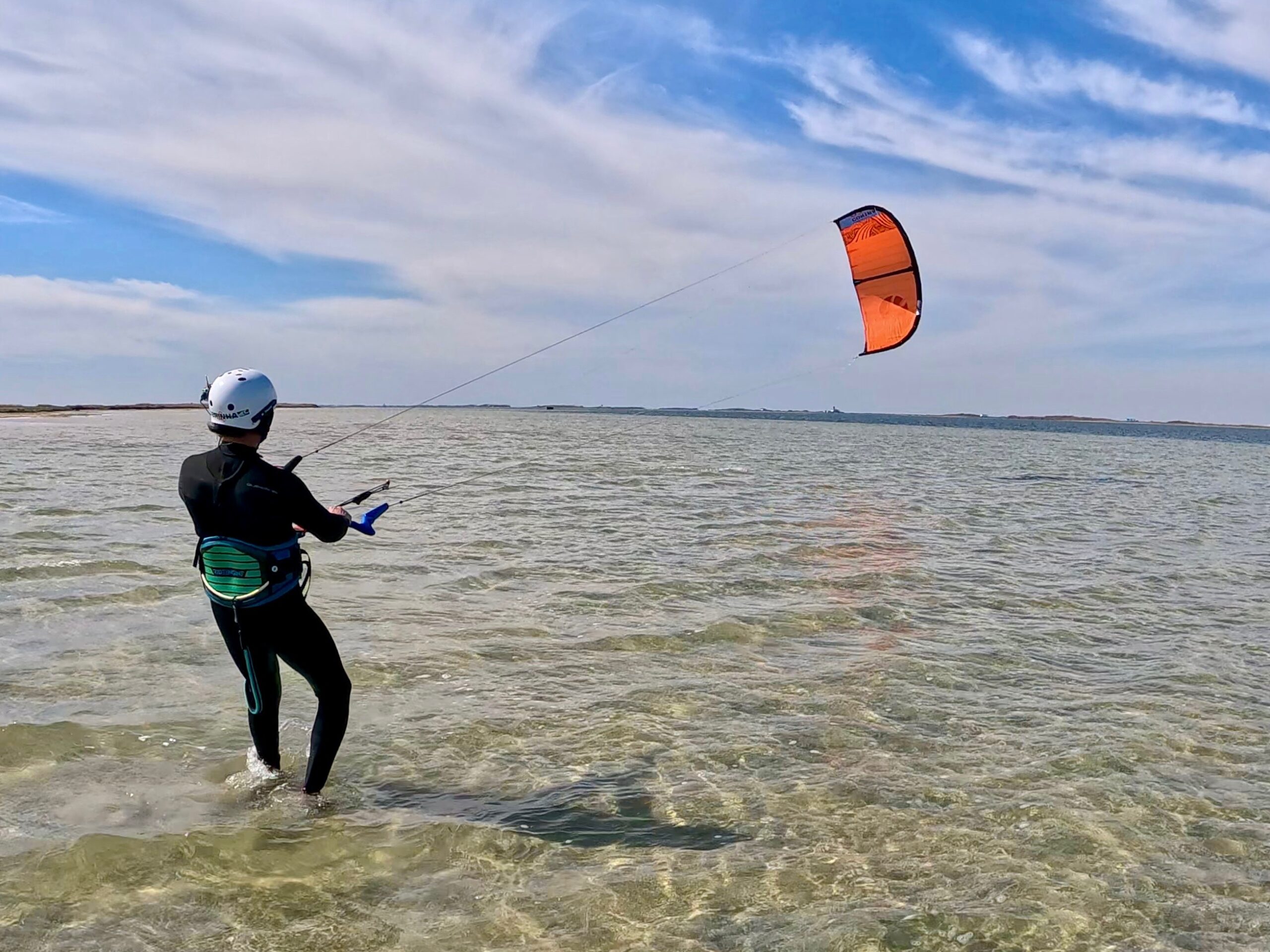
This is the big one. The Laguna Madre is a shallow hypersaline lagoon running down the bay side of Padre Island, and large sections of it are standing depth over a sandy bottom. You can walk out a long way and still have your head well clear of the water.
That sounds like a small detail but it really isn’t. Learning to kiteboard involves a lot of falling, and where you fall determines how quickly you improve. If every crash means treading water, recovering a kite in chop and getting progressively more tired, you learn slowly and you get scared. If every crash means standing up, resetting and going again, you get four times the attempts in the same hour.
Most kite schools in the world would love to have water like this. Very few of them do.
The wind shows up
Corpus Christi averages around 11 knots out of the east-southeast across the year, and spring runs considerably higher than that. April is the windiest month, averaging just over 14 mph with gusts past 40.
What matters for learning isn’t the peak, though, it’s the consistency. The southeast sea breeze is a reliable daily pattern for much of the year, which means a booked lesson is far less likely to get cancelled than it would be somewhere that depends on weather systems rolling through. You can plan a trip here and actually ride.
The water is warm
From roughly April into November you’re in boardshorts or a shorty. Cold water makes beginners tense, and tense beginners hold their breath, lock their arms and fight the kite instead of working with it. Warm water is a genuinely underrated teaching advantage.
It is cheap to get to and stay in
Corpus Christi isn’t a resort destination with resort prices. Flights into CRP connect through Dallas or Houston, or you can drive here from most of Texas in a few hours, and lodging is reasonable. Compared to flying to the Caribbean or Baja for a learning trip, this is a fraction of the cost.
You can progress here after you learn
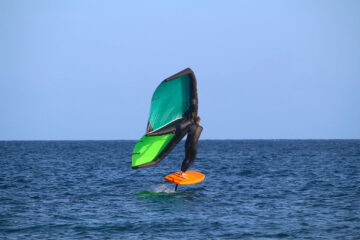
Some beginner spots are dead ends. You learn there and then you have to travel somewhere else to get any better. That isn’t the case here. Once you can ride, you’ve got flat water for tricks, Gulf beaches at Port Aransas for waves and strapless, and some of the best foiling water anywhere for when you head in that direction. The place grows with you.
The honest downsides
Spring can be too windy
April is fantastic if you already ride. It’s a lot if you’re on day one. I’ve had to move plenty of April lessons to a morning slot or a different day altogether, because 25 knots gusting 35 isn’t a teaching environment. If you’re booking a learning trip in spring, build in some flexible days and expect to ride mornings.
The summer heat is real
July and August on the Texas coast are hot in a way that people from cooler climates consistently underestimate. The wind is lovely and steady, but the gravel parking lot at two in the afternoon is not. Morning and evening sessions solve most of it, though it does shape how you plan your day.
It is not scenic in the postcard sense
If you’re picturing turquoise water and palm trees, adjust your expectations now. The Laguna is brown-green and shallow, the landscape is flat, and there are refineries visible across the bay from parts of town. The riding is excellent and the Instagram backdrop is average.
Honestly, I think that’s a big part of why the spot stays underrated, and I’m not entirely sad about it.
Jellyfish and the occasional sting
Some seasons bring jellyfish into the bay. It isn’t constant and it isn’t usually severe, but it does happen, and you’d rather know in advance than find out while standing in waist deep water wondering what just brushed past your leg.
Wind can go offshore in winter
Cold fronts swing the wind around to the north, which blows offshore at several of our launches. For an experienced rider with a local, that’s a manageable variable. For somebody learning on their own it’s a genuine hazard. Winter here asks for more judgment than summer does.
Who Corpus Christi is genuinely great for
It suits people who’ve never touched a kite and want the shortest path to riding, because the shallow water advantage is at its largest right at the beginning.
It suits nervous learners, people who aren’t strong swimmers, and anyone with a bit of anxiety about deep water, since standing depth removes most of what makes learning frightening in the first place.
It suits Texans and anyone within driving distance who wants to learn over a few weekends rather than committing to one intensive trip.
And it suits riders who want to learn to foil, because flat shallow water is the ideal foiling classroom and this coast has an enormous amount of it.
Who might be better served elsewhere
If you specifically want to learn in waves, this isn’t the place to start, although Port Aransas will serve you well once you can ride.
If you’re planning a one week trip in January and you can’t move your dates, the variability might frustrate you. Winter here is genuinely good sometimes and genuinely nothing at all other times.
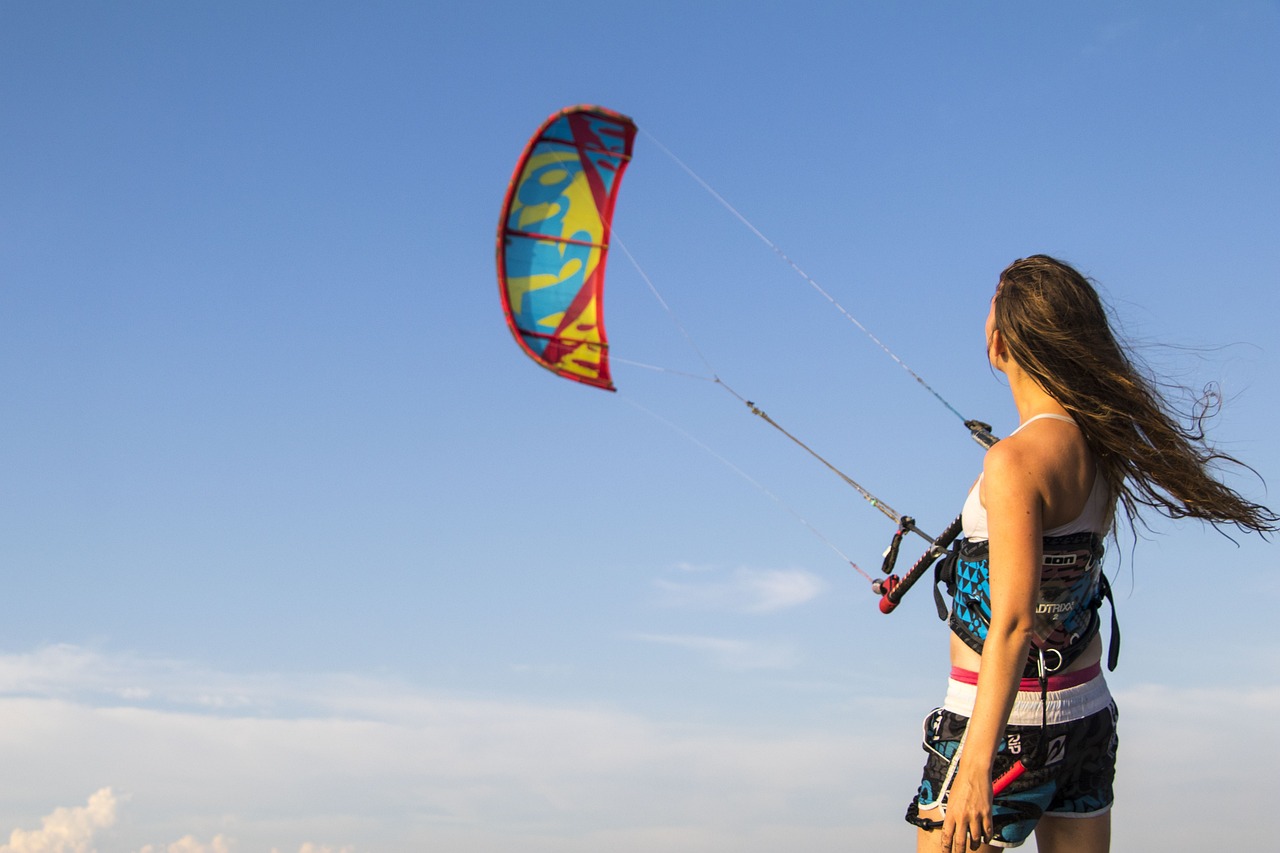
How long it takes here
Most people I teach are getting short rides somewhere in the range of six to nine hours of instruction, and riding consistently in both directions at around twelve. That’s faster than average, and the water is a big part of why.
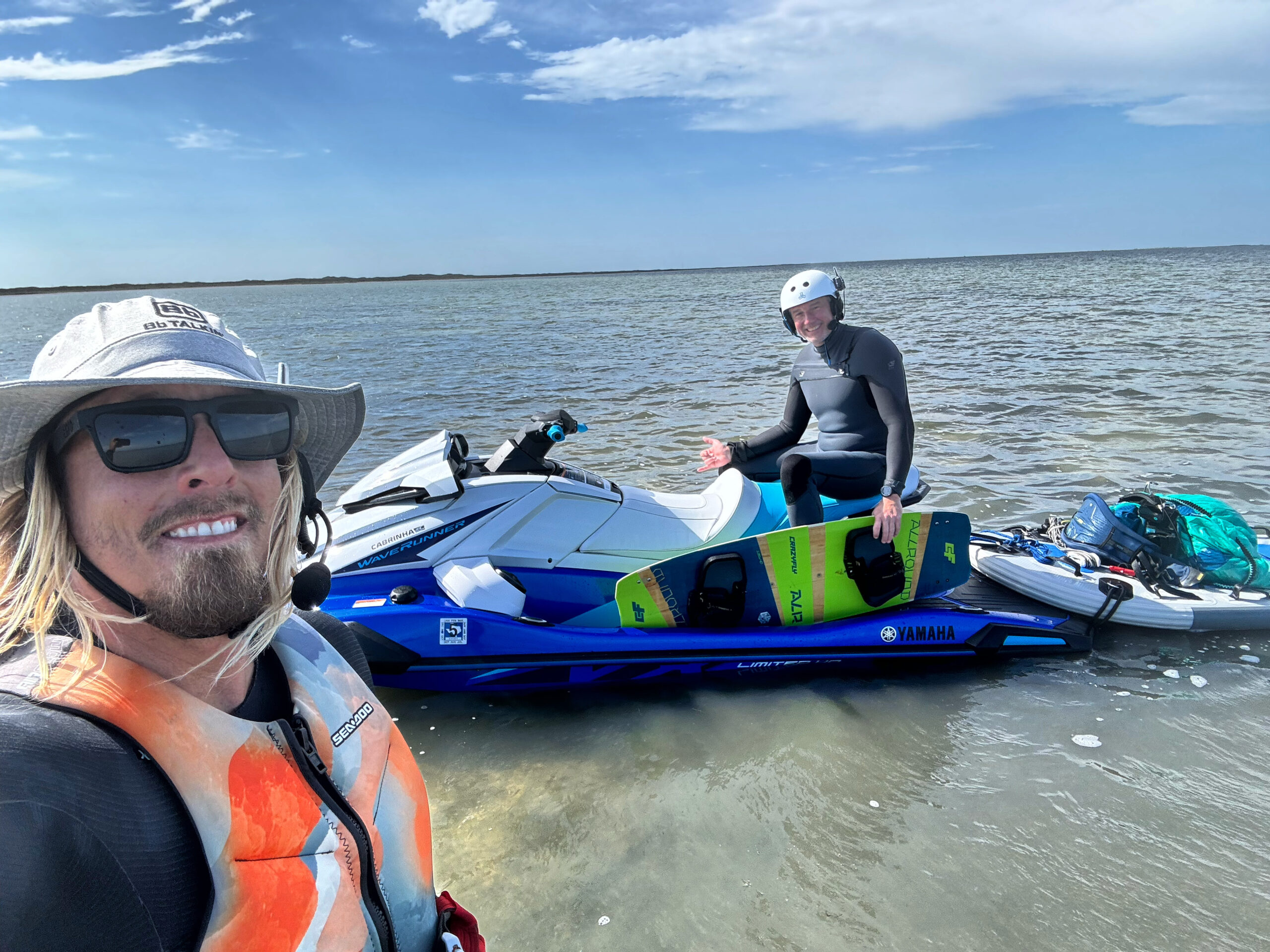
The other part is how we run lessons. We take a jet ski out to shallow water away from the busy launch, so you’re not walking upwind between attempts and you’re not learning in front of an audience. The helmets have Bluetooth, so I coach you in real time while you’re on the board rather than shouting from the beach and hoping some of it lands. Most beginner mistakes are small posture corrections, and hearing the fix at the exact moment it’s happening is worth an enormous amount.
Gear is included and it’s Cabrinha, so nobody’s learning on tired equipment.
Common questions
Is Corpus Christi a good place to learn to kiteboard?
Yes, and mostly because of the water. Large areas of the Laguna Madre are standing depth over sand, which lets beginners fail safely and get far more attempts per hour than deep water spots allow.
How many lessons do I need to learn to kiteboard?
Most people get short rides around the six to nine hour mark and ride consistently at around twelve. It varies with fitness, board sport background, and how many days in a row you can train.
Do I need to be a strong swimmer to learn here?
You should be comfortable in the water, but the shallow learning areas mean you’re standing rather than swimming for most of a beginner lesson. That’s one of the reasons nervous swimmers tend to do well here.
What is the best time of year to learn to kiteboard in Corpus Christi?
May through early July, or September and October. The wind in those windows is steady without being overpowering and the water is warm. Spring has more wind but it’s often too much for a first lesson.
Do I need my own gear for a lesson?
No, all equipment is included. Just bring a swimsuit, sunscreen and water.
Come find out
If any of this sounds like what you’re after, take a look at the kiteboarding lessons or book a session. If you’d rather talk it through first, call or text me at (979) 665-5729 or email Jvkiteboarding@gmail.com. Tell me your experience level and what you want out of it, and I’ll give you a straight answer about whether it’s worth the trip.
Worth reading next: the wind season guide for picking your dates, the realistic timeline for learning, and the local spot guide.